Home / Rendering
House rendering in Manchester
New render for fronts, backs, gable ends, extensions and whole houses, chosen to suit the wall and built to cope with the rain.
Four render systems
The quote always names the system we are proposing, so you can compare like with like.
Silicone
A meshed base coat with a thin coloured top coat. Water runs off it, it copes with slight movement and it keeps its colour. Our usual choice for brick and block.
Monocouche
A single thick coat, coloured through and scraped back to an even finish. Hard-wearing and good on large plain walls and new builds.
Sand and cement
The traditional way: scratch coat, float coat, then paint. Strong and easy to match into existing render when only part of a wall is redone.
Lime
For solid stone and older solid brick. It lets the wall dry out, which stops damp being trapped behind a hard coating.
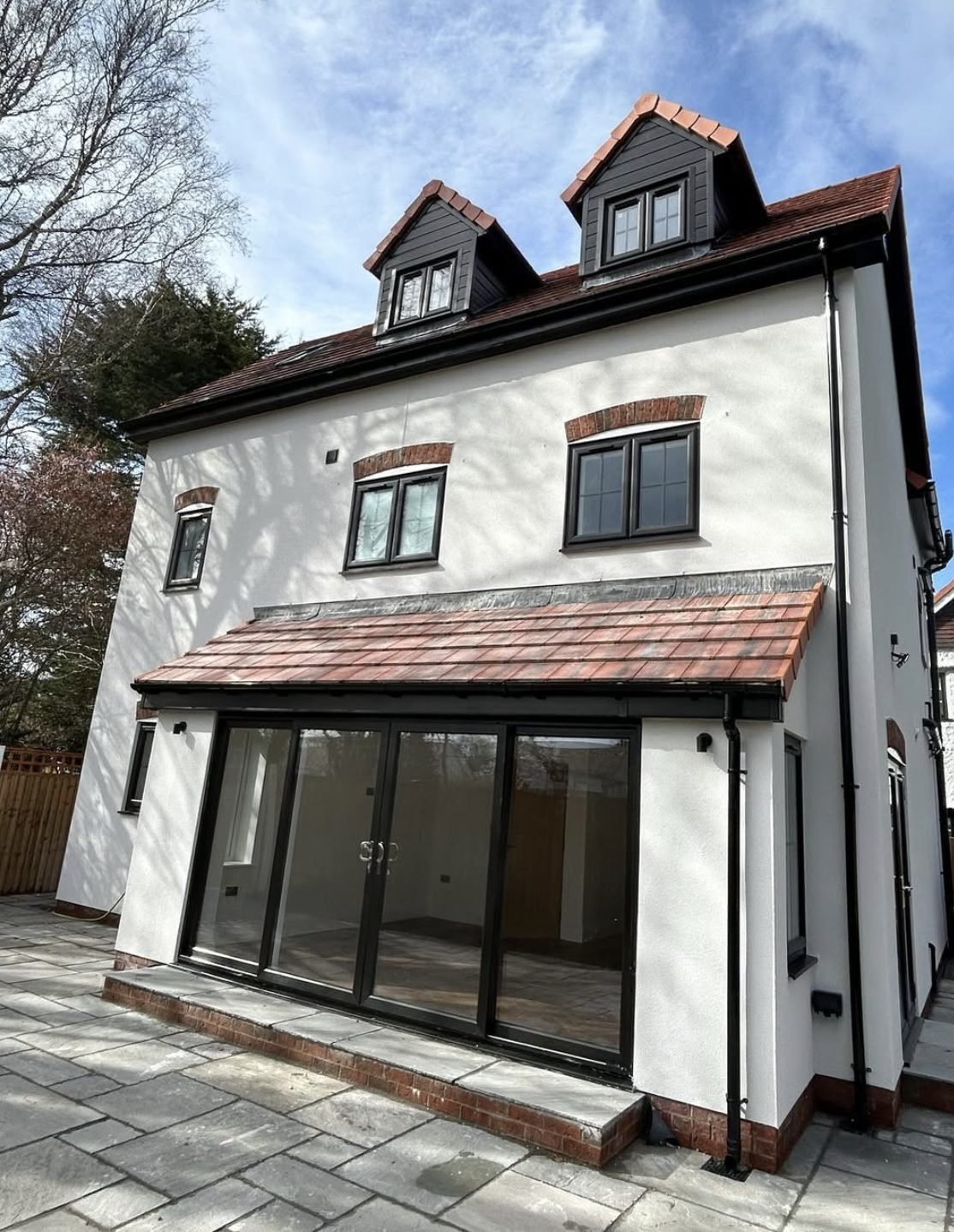
Where render helps most
On a lot of Manchester houses the front is red brick that the owner wants to keep. The walls that really need render are usually round the side and back.
- End-of-terrace gable walls that take the brunt of the weather
- Rear offshots with a single skin of brick and a cold, damp kitchen behind
- Back walls that have been patched and repointed for decades
- New kitchen and side-return extensions in blockwork
- Chimney stacks that are crumbling at the top
- Whole semis and detached houses, front included, where the owner wants a new look
How we render a house
Survey
We check the walls, gutters, sills and ground level, and look at access for scaffold.
Quote
A written price with the system, colour, scaffold and expected dates.
Scaffold and sheeting
Scaffold goes up, with sheeting where needed to keep showers off fresh work.
Prepare
Loose material comes off, cracks are dealt with, and everything not being rendered is masked.
Beads
Fixed to a line at corners, around openings and along the base, so edges are straight and water drips clear.
Base coat and mesh
The strong layer underneath, with mesh bedded right through it.
Top coat
Applied one full wall at a time so there are no visible joins.
Finish and clear
Fittings back on, masking off, scaffold down, everything cleaned.
Rendering questions
Which render is best for Manchester's weather?
For most brick and block houses, a silicone system. It sheds water rather than soaking it up, flexes a little without cracking and stays cleaner for longer, which matters in a wet climate. Solid stone walls are the exception and usually want lime.
Do you only render whole houses?
No. A lot of our work is one wall: a gable end that lets rain in, a rear offshot, an extension or a chimney stack. If a scaffold is going up anyway, it is worth asking about the chimney at the same time.
Does coloured render need painting?
Silicone and monocouche are coloured all the way through and do not need painting. Sand and cement render is normally painted, and the paint will need redoing from time to time.
Will rendering make my house warmer?
Render keeps rain out of the brickwork, and a dry wall loses less heat than a wet one, so a damp gable can feel noticeably better. But render is not insulation, and we will not sell it to you as such.
Can you render a new extension?
Yes. New blockwork shrinks as it dries out, so we mesh it fully and put movement beads where the extension meets the old house. Builders and homeowners both book us for this.
Will the render go green?
Any wall can grow algae if it stays damp and shaded, especially under trees. Silicone finishes resist it far better than painted render, and a gentle clean every few years keeps it at bay.
Ask about your house
Tell us which walls you are thinking about.
Not sure which walls need it?
We will look and tell you straight. The visit is free.